Replace one or more missing teeth with a fixed, natural-looking bridge — no surgery required. Trusted by families across Centerville and Greater Dayton for over 40 years.
Here’s the thing: losing a tooth affects more than just your smile. It changes how you chew and how you speak, and over time, it can cause the surrounding teeth to shift and the jawbone beneath the gap to weaken. A missing tooth is never just a cosmetic issue — it’s a structural one. And the longer it goes untreated, the more complicated and expensive the fix becomes. A dental bridge is one of the most proven, reliable ways to close that gap quickly, without surgery, and with results that look and feel completely natural.
At Centerville Dental Center, we’ve been placing dental bridges for patients across Centerville, Oakwood, Springboro, Carroll, Kettering, and the wider Greater Dayton area since 1983. A bridge is exactly what it sounds like — a fixed prosthetic that spans the space left by a missing tooth, anchored to the healthy teeth on either side. It restores your bite, protects your remaining teeth, and gives you back the confidence to smile, eat, and speak without thinking twice. And because it’s fixed — not removable — it functions just like your natural teeth.
If you’re missing a tooth and wondering whether a bridge is right for you, this page will walk you through everything you need to know. And if you’d rather just talk it through, call us at (937) 435-4150 — our dental team is happy to answer your questions before you ever book an appointment.
Many patients put off replacing a missing tooth because it doesn’t hurt and they’ve adjusted to eating around it. But here’s what’s happening underneath the surface—and why waiting makes things harder.
When a tooth is missing, the teeth on either side of the gap gradually begin to drift toward the space. Over months and years, this can throw off your bite alignment, create new gaps, and make it significantly harder to clean between teeth—increasing your risk of decay and gum disease. A bridge fills the gap immediately, holding your remaining teeth in their correct positions. Patients from Centerville, Oakwood, and Kettering come to us regularly after noticing this kind of shifting, and in most cases a bridge is still a viable option—but acting sooner is always better.
A missing tooth changes how you distribute bite force across your remaining teeth. Over time, the teeth that compensate for the gap experience more wear and stress than they were designed to handle. A dental bridge restores the full chewing surface, distributing bite forces evenly and protecting your remaining teeth from premature wear. Most patients tell us they didn’t realize how much the gap was affecting their eating until after the bridge was placed—and then they wonder why they waited so long.
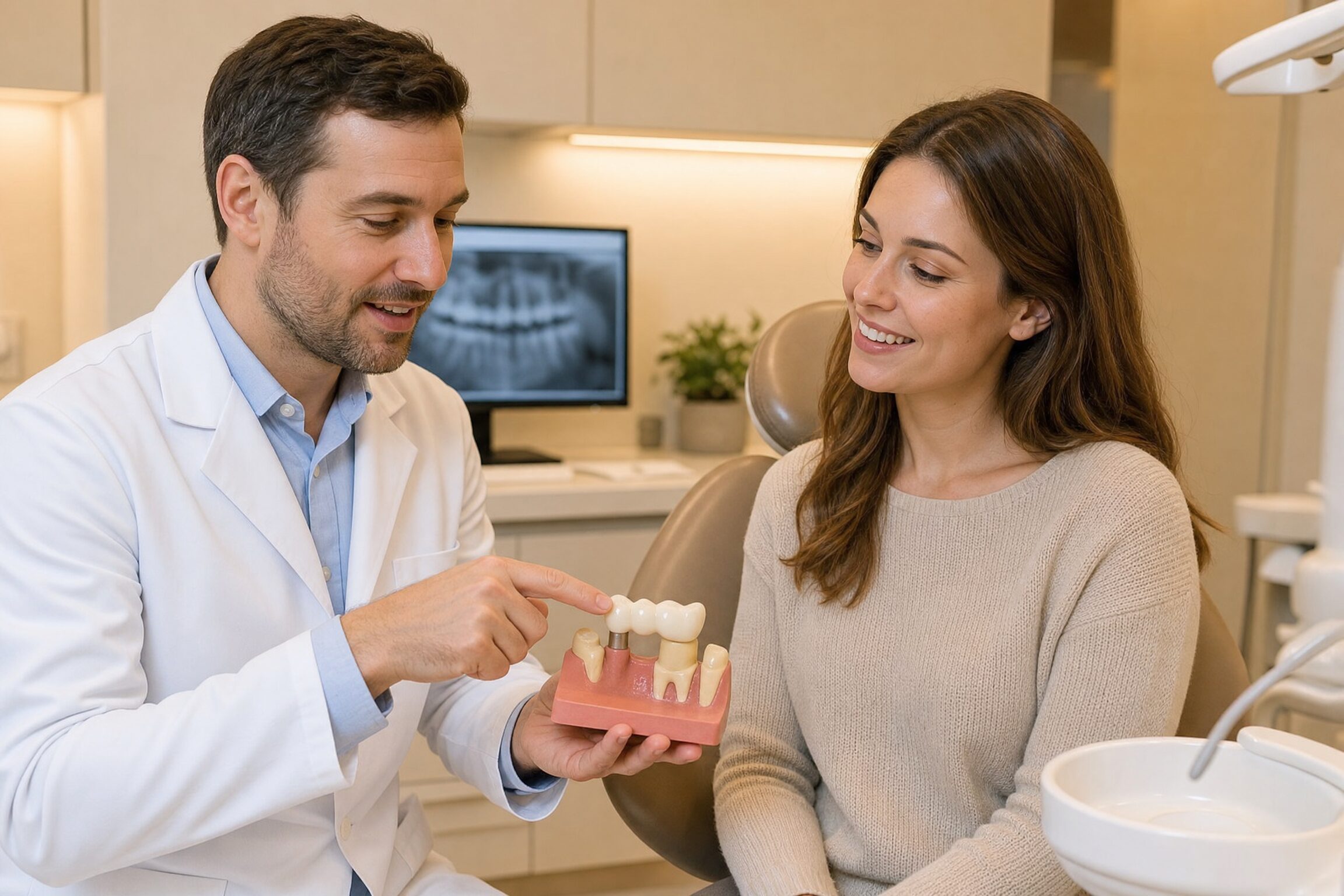
Unlike a dental implant, which requires a surgical procedure to place a titanium post in the jawbone, a traditional dental bridge is entirely non-surgical. It’s anchored to the healthy teeth on either side of the gap—called abutment teeth—using custom-fitted dental crowns. The artificial tooth in the middle, called the pontic, sits in the gap and is designed to match the color, shape, and size of your natural teeth. For patients who prefer to avoid surgery or who are not candidates for implants, a bridge is an excellent, proven alternative.
When a tooth is lost, the jawbone in that area no longer receives the stimulation it needs from chewing forces, and it begins to resorb—meaning it gradually shrinks. Over time, this can cause a subtle but noticeable change in the shape of your face, particularly around the cheeks and jaw. While a bridge does not prevent bone loss the way an implant does, it does restore chewing function and prevents the surrounding teeth from shifting—both of which help maintain the overall structure of your bite and face. For many patients in Springboro, Carroll, and across Greater Dayton, a bridge is the right long-term solution.
This one matters more than people often admit. A missing tooth — especially one that’s visible when you smile or speak — affects how you feel about yourself in social and professional situations. Patients tell us they’ve stopped smiling in photos, avoided certain conversations, or felt self-conscious at work. A well-crafted bridge eliminates that. We take the time to match the shade, shape, and size of the pontic to your surrounding teeth so that nobody — including you — will be able to tell the difference. Confidence is part of your oral health too.
Your Questions, Answered Honestly.
Will it look natural? Yes — when it’s done well. We use high-quality porcelain and ceramic materials that are shade-matched to your surrounding teeth, taking into account color, translucency, and surface texture. The result looks like a natural tooth. In fact, most patients tell us that friends and family have no idea which tooth is the bridge. That’s exactly what we’re aiming for.
Does the procedure hurt? The preparation of the abutment teeth is done under local anesthesia, so you won’t feel pain during the appointment. Some mild sensitivity for a few days afterward is normal and manageable with over-the-counter pain relievers. By the time your permanent bridge is cemented, most patients report no discomfort at all. If you have dental anxiety, let us know before your appointment — we have options to help you stay comfortable throughout.
How much does it cost? Bridge costs vary depending on the number of teeth being replaced and the materials used. Most dental insurance plans cover a significant portion of bridge treatment when it’s medically necessary. Our front desk team will verify your benefits before your appointment so you know exactly what to expect. We also offer flexible financing options for any remaining balance. Call us at (937) 435-4150, and we’ll walk through the numbers with you honestly before you commit to anything.
Centerville Dental Center has been part of this community since 1983 — over 40 years of serving families in Centerville, Oakwood, Springboro, Carroll, Kettering, and across the Greater Dayton area. We’ve placed hundreds of dental bridges over the decades, and we approach every case with the same care and precision we’d want for our own families. When you come to us for a bridge, you’re not getting a rushed, one-size-fits-all solution. You’re getting a custom restoration that’s designed specifically for your mouth, your bite, and your smile.
We use high-quality materials and work with trusted dental laboratories to ensure your bridge is durable, natural-looking, and precisely fitted. We’ll check the bite carefully, make any necessary adjustments before cementing, and follow up to make sure everything feels right. If anything doesn’t feel correct after placement, we want to know immediately, and we’ll make it right. Our office is located at 9346 Dayton Lebanon Pike, Centerville, OH 45458, and we offer convenient appointment times to work around your schedule. We’re easy to reach from Kettering, Oakwood, Springboro, and Carroll.

Getting a dental bridge typically requires two appointments at our Centerville office. At the first appointment, we prepare the abutment teeth — the healthy teeth on either side of the gap — by removing a small amount of enamel to make room for the crowns that will anchor the bridge. We take impressions of the prepared teeth and the gap and place temporary crowns to protect the abutment teeth while your permanent bridge is being fabricated by our dental laboratory. This first appointment usually takes about one to one and a half hours.
The permanent bridge is typically ready within one to two weeks. At your second appointment, we remove the temporary crowns, check the fit and shade of the permanent bridge carefully, make any necessary adjustments, and cement it into place. This appointment is usually shorter — around 30 to 45 minutes. From start to finish, most patients in Centerville, Oakwood, Kettering, and the surrounding areas complete their bridge treatment within two to three weeks.
Most patients are pleasantly surprised by how comfortable the dental bridge process is. During the first appointment, we use local anesthesia to completely numb the area around the abutment teeth before we begin any preparation work. You should feel pressure but no sharp pain during the procedure. If you feel anxious about dental visits, please let us know — we offer options to help you feel more relaxed throughout your appointment.
After the anesthesia wears off, you may experience some mild sensitivity or soreness in the treated area for a few days, which is completely normal and typically manageable with over-the-counter pain relievers. Once your permanent bridge is placed, most patients report that it feels very natural. If you experience any significant discomfort, unusual bite pressure, or sensitivity that lingers beyond a couple of weeks, contact our Centerville office right away so we can make sure everything is fitting perfectly.
Many dental insurance plans do provide partial coverage for dental bridges because they are considered a restorative procedure. The amount your plan covers will depend on your specific policy, your annual maximum benefit, and whether you have met your deductible for the year. At Centerville Dental Center, our front office team is experienced in working with a wide range of insurance providers and will verify your benefits before treatment begins.
We will give you a clear, itemized breakdown of what your insurance is expected to cover and what your out-of-pocket responsibility will be so there are never any surprises. For patients who have limited or no insurance coverage, we also offer flexible financing options through trusted third-party providers, making it easier to move forward with the care you need at a monthly payment that works within your budget. Don’t let cost questions hold you back—reach out to our Centerville team at (937) 435-4150, and we’ll help you find a path forward.
Both dental bridges and dental implants are excellent options for replacing one or more missing teeth, but they work in very different ways. A traditional dental bridge is a fixed prosthetic that is anchored to the healthy teeth on either side of the gap. It does not require surgery and can typically be completed in two appointments. A dental implant, on the other hand, involves placing a titanium post surgically into the jawbone, which then fuses with the bone over several months before a crown is attached.
Implants are generally considered the gold standard because they preserve bone volume and do not require altering adjacent teeth. However, bridges are an excellent, proven alternative for patients who are not candidates for surgery, prefer a faster process, or want a more budget-friendly solution. During your consultation at Centerville Dental Center, we will review your oral health, bone density, and personal goals to help you decide which option is the best fit for your unique situation.
Caring for your dental bridge is straightforward once you get into a consistent routine. Brushing twice a day with a soft-bristled toothbrush and fluoride toothpaste is essential, paying close attention to the area where the bridge meets your gums. Because a traditional bridge spans the gap where your missing tooth once was, you cannot floss between the bridge and the gum the normal way. Instead, use a floss threader, interdental brushes, or a water flosser to clean underneath the pontic—the artificial tooth—to remove plaque and food debris that can build up and cause decay in the supporting abutment teeth.
Rinsing with an antibacterial mouthwash each day can also help keep bacteria levels low in those hard-to-reach areas. Beyond your at-home routine, attending your regular six-month checkups at our Centerville office is essential — we’ll professionally clean around the bridge, check the fit and integrity of the crowns, and catch any early signs of decay or gum disease before they become bigger problems. With proper care, a well-made dental bridge can last 10 to 15 years or longer.