When a tooth cannot be saved, our compassionate team at Centerville Dental Center provides safe, comfortable extractions — so you can move forward with a healthy, pain-free smile.
REQUEST AN APPOINTMENT CALL (937) 435-4150| Detail | What to Expect |
|---|---|
| Procedure Time | 20 – 90 minutes depending on complexity |
| Anesthesia | Local anesthesia; sedation options available |
| Recovery Time | 1 – 3 days for simple; 3 – 7 days for surgical |
| Discomfort Level | Minimal during procedure; manageable post-op |
| Return to Work | Same day or next day for most patients |
| Tooth Replacement | Implants, bridges, or dentures available |
At Centerville Dental Center, we understand that the idea of having a tooth removed can feel daunting. Our priority is always to preserve your natural teeth — but when extraction is the safest, most effective path forward, you can trust our experienced dental team to make the process as gentle and stress-free as possible.
Whether you’re dealing with severe decay, a painful infection, overcrowding, or an impacted wisdom tooth, we use advanced techniques and compassionate care to ensure your comfort from the first consultation through full recovery.
Our dentists always explore every option to save a natural tooth before recommending extraction. There are situations, however, where removing a tooth is genuinely the best path forward for your long-term oral health. Patients from Centerville, Oakwood, Springboro, Carroll, Kettering, and across the Greater Dayton area come to us with these common situations every week.
When decay has progressed so deeply into a tooth that a filling, crown, or root canal can no longer restore it to function, extraction becomes the safest choice. Leaving a severely decayed tooth in place risks spreading infection to neighboring teeth and the surrounding jawbone. We’ll always discuss your options honestly before recommending removal.
A tooth abscess is a bacterial infection that can spread rapidly if left untreated. When an infection is too advanced for a root canal to resolve, extraction eliminates the source of infection and protects the rest of your mouth. Patients across Centerville and Kettering trust us to handle these urgent situations quickly and safely.
Wisdom teeth that are partially or fully trapped beneath the gumline can cause pain, crowding, and infection. Removing impacted wisdom teeth before they cause damage is one of the most common procedures we perform for patients from Springboro, Carroll, and the surrounding Greater Dayton area.
Sometimes a tooth must be removed to create the space needed for orthodontic treatment to work effectively. This is a planned, strategic extraction — not an emergency — and it’s a routine part of many patients’ smile journeys.
A tooth fractured below the gumline often cannot be restored with a crown or bonding. In these cases, extraction followed by a tooth replacement option such as an implant or bridge gives you the best long-term outcome for your smile and bite function.
We Always Try to Save Your Tooth First
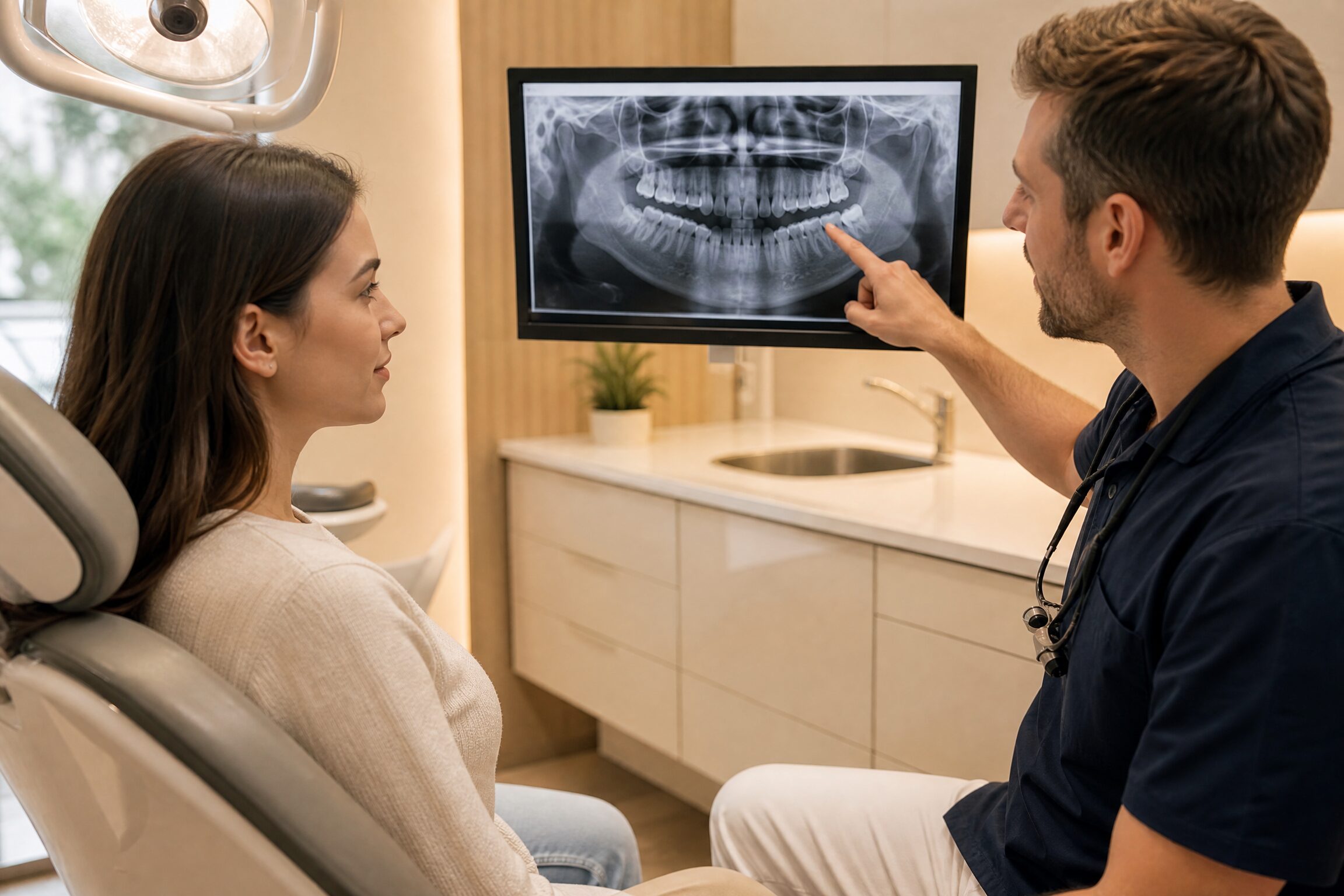
Extraction is never our first recommendation. Our team will thoroughly evaluate your tooth with digital X-rays and a clinical exam before discussing all available options with you. If extraction is the right choice, we’ll explain exactly why — and walk you through every step of the process and your replacement options before we begin.

Losing a tooth doesn’t have to mean living with a gap. At Centerville Dental Center, we offer several proven tooth replacement solutions to restore your smile’s function, health, and beauty. We’ll discuss the best option for your specific situation, budget, and long-term goals.
The gold standard in tooth replacement. A titanium post is surgically placed into the jawbone to act as an artificial root, then topped with a lifelike porcelain crown. Implants look, feel, and function like natural teeth — and they preserve jawbone density over time.
A dental bridge “bridges” the gap left by a missing tooth using crowns placed on the adjacent natural teeth as anchors. Bridges restore your bite and smile without surgery and can typically be completed in just two visits.
For patients missing multiple teeth or an entire arch, modern dentures are more comfortable and natural-looking than ever before. We offer full dentures, partial dentures, and implant-supported dentures for maximum stability.
Understanding what to expect during recovery helps you plan and heal faster. Most patients are surprised by how manageable the process is—especially with the clear aftercare instructions our team provides at every appointment.
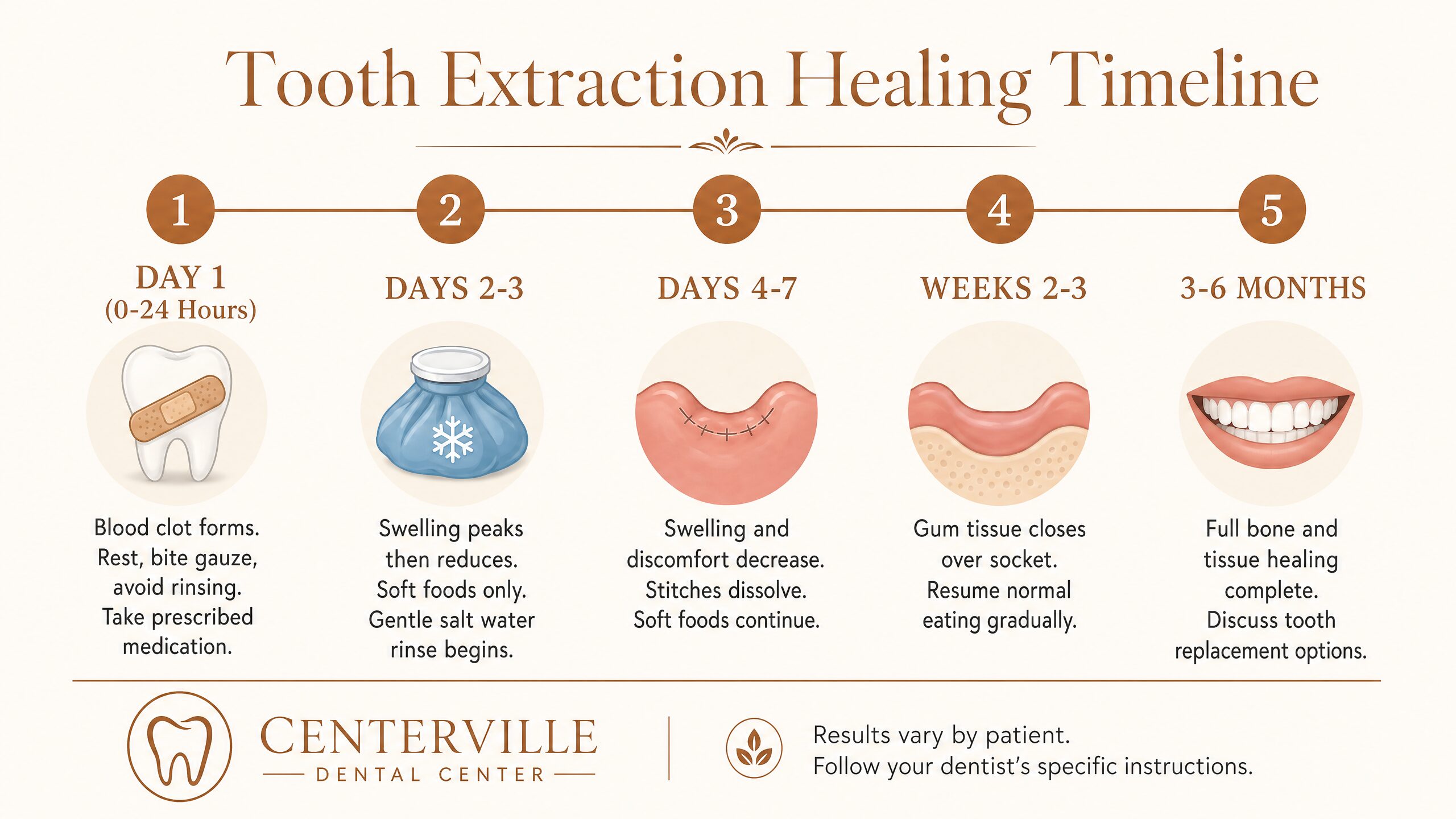
A blood clot forms in the socket—this clot is essential for healing and must be protected.
Swelling and discomfort typically peak around day two or three before beginning to subside.
Most patients feel significantly better by day four. Swelling continues to decrease, and the socket begins to close.
The gum tissue closes over the extraction site. Stitches (if placed) will dissolve or be removed at a follow-up visit.
Centerville Dental Center has served this community for over 40 years. When you need a tooth removed, you want a team that is experienced, honest, and genuinely caring — not one that rushes you through the door. Our patients from Centerville, Oakwood, Springboro, Carroll, Kettering, and across the Greater Dayton area trust us because we take the time to explain everything, answer every question, and make sure you feel comfortable before, during, and after your procedure.
We use digital X-rays for precise diagnosis, offer sedation options for anxious patients, and provide detailed aftercare instructions so your recovery is as smooth as possible. Before any treatment begins, we’ll walk you through exactly what’s involved and what to expect financially. We accept most major dental insurance plans and offer flexible payment options for patients without coverage.
Our address is 9346 Dayton Lebanon Pike, Centerville, OH 45458. Call us at (937) 435-4150 — we’re here to help.
No, the extraction procedure itself should not hurt. We use profound local anesthesia to completely numb the tooth and surrounding area before beginning. You will feel pressure and movement, but no sharp pain. If you experience any discomfort during the procedure, let us know immediately and we will administer more anesthesia. Sedation options are also available for patients who feel anxious.
Dry socket occurs when the blood clot that forms in the extraction site is dislodged or dissolves before the wound has healed, exposing the underlying bone and nerves. It causes a deep, throbbing ache that typically begins 2–4 days after extraction. To prevent it, avoid smoking, drinking through a straw, forceful spitting, and vigorous rinsing for at least 48–72 hours after your extraction. If you suspect dry socket, call us right away—it’s easily treated in our office.
For the first 24–48 hours, stick to a soft food diet. Excellent options include yogurt, applesauce, mashed potatoes, scrambled eggs, smoothies, and lukewarm soups. Avoid hot liquids, spicy foods, crunchy snacks, and foods with small seeds that could get trapped in the extraction site. By days 4–7, most patients can begin reintroducing semi-solid foods as comfort allows.
Most patients feel comfortable returning to normal activities within 1–3 days for a simple extraction. Surgical extractions (such as impacted wisdom teeth) may require 3–7 days before you feel back to normal. The gum tissue typically closes over the socket within 1–2 weeks, though complete bone healing takes several months. We’ll give you a clear timeline based on your specific procedure.
In most cases, yes — replacing a missing tooth is strongly recommended. When a tooth is missing, the surrounding teeth can shift into the gap over time, affecting your bite and potentially causing jaw pain. The jawbone in the area also begins to deteriorate without the stimulation a tooth root provides. We offer dental implants, bridges, and dentures to restore your smile and protect your long-term oral health. We’ll discuss the best option for you at your appointment.