That twinge when you sip your morning coffee. The dull ache that shows up after lunch. The tiny dark spot you keep noticing every time you brush. Sound familiar? Honestly, most people ignore these signals for weeks – sometimes months – telling themselves it will just go away. Spoiler: it usually doesn’t. Cavities are sneaky, and by the time they start making noise, they’ve often been quietly growing for a while.
Here’s the thing – catching a cavity early can mean the difference between a simple filling and a much bigger procedure down the road. At Centerville Dental Center, we see patients from Centerville, Oakwood, Springboro, Carroll, Kettering, and all across the Greater Dayton area who come in thinking something is “probably nothing” – and it turns out to be something very treatable, as long as we catch it in time.
This post walks you through the most common signs that you may have a cavity, what causes them, and what you can do about it. No dental degree required – just a few minutes of reading that could save your tooth.
What Is a Cavity & What Causes It?
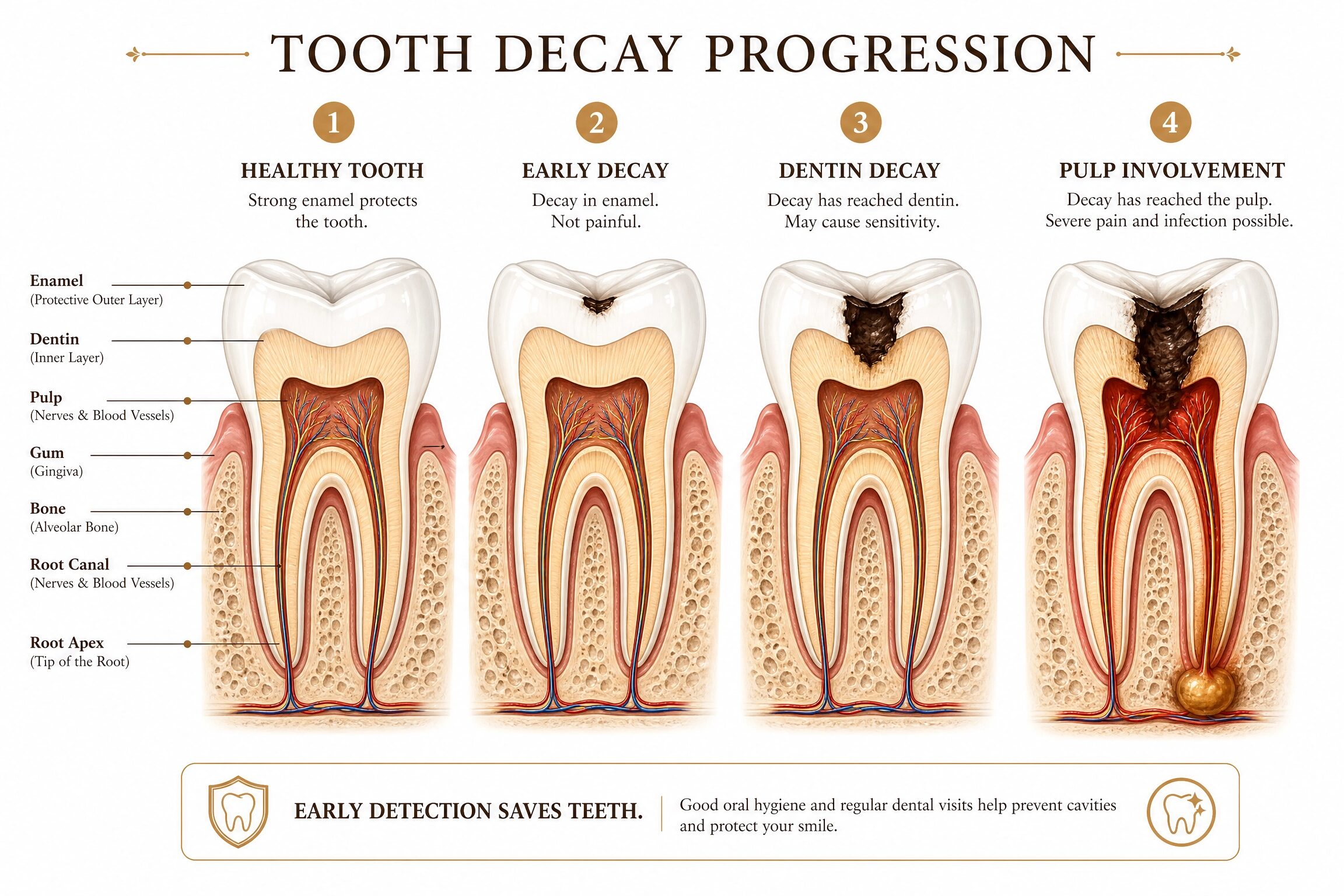
A cavity – also called dental caries or tooth decay – is essentially a hole that forms in your tooth. It starts when bacteria in your mouth feed on sugars and starches, producing acids that slowly erode your tooth enamel. Let me explain why that matters: enamel is the hard outer shell protecting your tooth. Once that shield breaks down, the softer inner layers of your tooth become vulnerable, and decay can spread fast.
Cavities are one of the most common chronic health conditions in the world – more common than you might think. They affect children and adults alike, and no tooth is completely immune. Here are the main factors that contribute to cavity formation:
Bacteria buildup: Streptococcus mutans and other oral bacteria thrive in plaque – that sticky film that coats your teeth when you skip brushing.
Frequent sugar and starch consumption: Every time you eat or drink something sugary, bacteria get a fresh fuel source to produce enamel-eroding acid.
Dry mouth: Saliva is your mouth’s natural defense system – it neutralizes acids and washes away food particles. Less saliva means more decay risk.
Poor oral hygiene: Infrequent brushing and flossing allows plaque to harden into tartar, which only a professional cleaning can remove.
Deep tooth grooves: Back molars have pits and fissures that trap food and bacteria more easily than smooth front teeth.
Acid reflux or frequent vomiting: Stomach acid reaching the mouth can wear down enamel over time, even without sugar being involved.
Skipping dental checkups: Without regular X-rays and exams, small cavities go undetected until they become big problems.
Good to know: Cavities don’t always hurt right away. In their earliest stages, they cause zero symptoms – which is exactly why routine dental exams are so important for catching decay before it causes real damage.
Common Signs You May Have a Cavity
Here’s where things get interesting – and honestly, a little counterintuitive. You might assume that a cavity always comes with obvious, dramatic pain. Not always. Some cavities whisper before they scream. Others announce themselves loudly from the start. The signs below can range from barely noticeable to impossible to ignore, depending on how far along the decay has progressed.
1. Tooth Sensitivity
Sensitivity is often the first sign that something is off – and it’s easy to dismiss as “just sensitive teeth.” But there’s a difference between general sensitivity and the kind that signals a cavity forming beneath the surface.
A sharp, sudden zing when eating or drinking something hot, cold, or sweet
Sensitivity that lingers for several seconds after the trigger is removed
Discomfort localized to one specific tooth rather than spread across several
Sensitivity that has recently appeared or worsened without explanation
When enamel erodes, the dentin underneath – which contains tiny fluid-filled tubes connected to your nerve – becomes exposed, and that’s when temperature changes start to sting in a very specific, pointed way.
2. Tooth Pain or Ache
Pain is the signal your tooth sends when it’s really trying to get your attention. By the time a cavity is causing a persistent ache, the decay has usually moved deeper into the tooth structure.
A dull, throbbing ache in one tooth or a general area of your mouth
Sharp pain when biting down or chewing – even on soft foods
Pain that comes and goes, making you think the problem has resolved itself (it hasn’t)
Nighttime toothaches that wake you up or make it hard to fall asleep
Don’t be fooled if the pain disappears for a few days – that can sometimes mean the nerve is becoming more severely damaged, not that the cavity healed on its own.
3. Visible Holes or Dark Spots
Sometimes you can actually see a cavity forming – and that visual clue is worth taking seriously, even if there’s no pain yet.
A visible pit, hole, or rough divot on the surface of a tooth
Brown, black, or gray discoloration on a tooth that wasn’t there before
White chalky spots on enamel – these can be early-stage demineralization, a precursor to a full cavity
Staining that doesn’t come off with brushing or professional cleaning
Not every dark spot is a cavity – staining from coffee, tea, or tobacco can look similar – but any new discoloration or structural change in your tooth deserves a professional look.
4. Bad Breath or Unpleasant Taste
Persistent bad breath – the kind that doesn’t go away after brushing – can be a sign that bacteria have set up shop inside a decaying tooth. It’s not glamorous, but it’s worth knowing.
Chronic bad breath that returns quickly after brushing and rinsing
A sour, bitter, or metallic taste that lingers throughout the day
A foul taste concentrated near one specific tooth or area
Bad breath that isn’t explained by diet, dry mouth, or gum disease
The decaying organic material inside a cavity – combined with the bacterial activity happening there – produces sulfur compounds and other byproducts that cause that unmistakable unpleasant odor.
5. Pain When Eating Sweet Foods
This one surprises a lot of people – they expect cold sensitivity but don’t realize that sweet foods can trigger cavity-related discomfort just as reliably.
A sharp twinge or ache when eating candy, cookies, fruit, or sweetened drinks
Discomfort that appears immediately upon contact with the sugary food
Pain that is localized to one tooth rather than a general mouth sensitivity
Sensitivity to sweet foods that has developed recently without a clear cause
Sugar triggers fluid movement in the dentin tubules – those tiny channels connecting the outer tooth to the nerve – and when enamel is compromised by decay, that movement creates a quick, sharp pain response that’s very characteristic of a cavity.
Experiencing any of these signs? Don’t wait. The sooner a cavity is identified, the simpler – and less expensive – the treatment. Patients throughout Centerville, Springboro,
Experiencing any of these signs? Don’t wait. The sooner a cavity is identified, the simpler – and less expensive – the treatment. Patients throughout Centerville, Springboro, Oakwood, and Kettering trust Centerville Dental Center to handle decay gently and effectively.
What Happens If a Cavity Is Not Treated?
Honestly, this is where a lot of people get into trouble. They notice a minor twinge, assume it’ll pass, and put off scheduling an appointment. And sometimes – temporarily – it does seem to calm down. But here’s the thing: that doesn’t mean the cavity healed. It means the decay has progressed deep enough to damage the nerve, which actually reduces pain signals temporarily. That’s not good news. That’s a warning sign you’ve crossed into more serious territory.
Untreated cavities don’t stay small. Decay is an active, ongoing bacterial process – and without intervention, it spreads. Here’s what can happen when a cavity is left alone:
Deeper decay into the dentin: Once enamel is breached, decay moves quickly through the softer dentin layer underneath – sensitivity and pain typically intensify at this stage.
Pulp infection: When bacteria reach the inner pulp – the soft tissue containing nerves and blood vessels – you’re now dealing with an infected tooth. This is significantly more painful and requires root canal therapy rather than a simple filling.
Dental abscess: A bacterial infection can form a pocket of pus at the root tip, causing severe throbbing pain, swelling, and in serious cases, spreading infection that can affect surrounding teeth, your jaw, and even your overall health.
Tooth fracture: A cavity weakens the structural integrity of the tooth. Without enough healthy tooth structure remaining, the tooth becomes vulnerable to cracking – especially under the pressure of chewing.
Tooth loss: When decay is too extensive to save the tooth – or when an abscess has caused irreversible damage – extraction may be the only remaining option.
Spread to neighboring teeth: The bacteria responsible for decay don’t stay contained. They can spread to adjacent teeth, multiplying your problems and your treatment costs.
Increased treatment complexity and cost: A small cavity treated early is a quick, affordable filling. That same cavity ignored for months can become a root canal, a crown, or an extraction followed by a dental implant – a dramatically more involved and expensive process.
Let me explain why early treatment matters so much: catching decay when it’s still confined to the enamel or early dentin means a straightforward filling – usually completed in a single visit. Waiting until it reaches the pulp means root canal therapy, a crown, and considerably more time in the chair. The tooth is the same tooth. The difference is entirely in how early you acted.
How Centerville Dental Center Treats Cavities
The right treatment for a cavity depends on how far the decay has progressed. At Centerville Dental Center, we take a thorough, individualized approach – examining each tooth carefully, reviewing X-rays, and discussing your options with you before any treatment begins. No surprises, no pressure.
Here’s a clear breakdown of how we address cavities at different stages:
Fluoride Treatment (Very Early Stage)
If we catch demineralization – the very beginning of enamel breakdown before a true cavity has formed – a professional fluoride treatment can actually reverse the process. This is the best possible outcome, and it’s only possible with regular check-ups that catch problems this early.
Tooth-Colored Composite Fillings
For most cavities – those that have progressed through enamel and into the dentin – a composite resin filling is the standard treatment. We remove the decayed portion of the tooth, clean the area thoroughly, and fill it with a tooth-colored composite material that bonds directly to the tooth structure. The result looks completely natural, and the procedure is typically completed in one visit. Patients from Carroll, Springboro, and across the Greater Dayton area appreciate how seamless these restorations look.
Completed in a single appointment in most cases
Matched to your natural tooth color for an invisible repair
Preserves more healthy tooth structure than older amalgam fillings
Durable and long-lasting with proper care
Dental Crowns
When decay is extensive – covering a large portion of the tooth or causing significant structural weakness – a filling alone may not provide enough support. In these cases, a dental crown is placed over the entire visible portion of the tooth, restoring its shape, strength, and function. Crowns are also used after root canal therapy to protect the treated tooth.
Root Canal Therapy
If decay has reached the pulp – the nerve-containing center of the tooth – root canal therapy removes the infected tissue, cleans and shapes the root canals, and seals the tooth. Honestly, root canals have a bad reputation that they don’t entirely deserve. Modern techniques and local anesthesia make the procedure far more comfortable than most people expect. And the alternative – losing the tooth entirely – is far worse.
Tooth Extraction (When Necessary)
When a tooth is too damaged by decay to be saved – or when an abscess has caused irreversible bone loss – extraction becomes necessary. We always discuss tooth replacement options at the same time, because leaving a gap affects the alignment and health of surrounding teeth over time.
How to Prevent Cavities
Here’s some genuinely good news: cavities are largely preventable. Not entirely – genetics, medications, and certain health conditions do play a role – but the vast majority of decay can be stopped before it starts with consistent habits and regular professional care. Let me explain what actually makes a difference.
Daily Habits That Protect Your Teeth
Brush twice daily with fluoride toothpaste: Two minutes each time, covering all surfaces – including the backs of your molars and along the gumline. Most people brush for about 45 seconds. That’s not enough.
Floss once a day: Cavities form between teeth just as readily as they form on chewing surfaces. Your toothbrush can’t reach those contact points – floss can. No substitutes here.
Limit sugary and acidic foods and drinks: This doesn’t mean eliminating them entirely – it means being mindful of frequency. Sipping a sugary drink over two hours is far more damaging than drinking it in one sitting, because it keeps your mouth in a constant acidic state.
Drink water – especially fluoridated tap water: Water rinses away food particles and acids, and fluoridated water actively strengthens enamel. It’s one of the most underrated cavity-prevention tools available.
Don’t snack constantly: Every time you eat, bacteria produce acid for about 20 minutes afterward. Three meals a day gives your saliva time to neutralize that acid between episodes. Constant snacking keeps acid levels elevated all day.
Use a mouthwash with fluoride: An antimicrobial or fluoride rinse adds an extra layer of protection – particularly useful for people who are cavity-prone or have dry mouth.
Consider dental sealants: Particularly valuable for children, but also used in adults – sealants are thin protective coatings applied to the chewing surfaces of back teeth, physically blocking bacteria from settling into the grooves where decay most commonly begins.
The Role of Regular Dental Visits
No amount of excellent home care completely replaces professional cleanings and exams. Here’s why: tartar – hardened plaque – cannot be removed by brushing or flossing alone. It requires professional instruments. And early-stage decay, often visible only on X-rays, is completely asymptomatic. You won’t feel it. You won’t see it. But a dental exam will catch it.
Most adults benefit from check-ups every six months. Some patients – those with a history of frequent cavities, dry mouth, or gum disease – may need to come in more frequently. Your dentist can help you figure out the right schedule for your specific situation.
Residents of Centerville, Kettering, Oakwood, Carroll, Springboro, and the broader Greater Dayton area – Centerville Dental Center is here for your routine preventive care as much as your restorative needs. Keeping your teeth healthy long-term is always the goal.
Think You Might Have a Cavity? Don’t Wait.
Think You Might Have a Cavity? Don’t Wait.
The sooner a cavity is treated, the simpler — and less costly — the solution. At Centerville Dental Center, our caring team is ready to help you get back to a healthy, pain-free smile. Visit us at 9346 Dayton Lebanon Pike, Centerville, OH 45458, or reach out today to schedule your exam. We make it easy to get the care you need.
In the earliest stages, a cavity may produce no noticeable symptoms at all, which is why routine dental checkups are so important. As decay progresses, you might notice mild tooth sensitivity to sweet, hot, or cold foods, or a faint ache that comes and goes. Many patients are surprised to learn they have a cavity only after a dental X-ray reveals it. Catching decay at this stage means treatment is typically quick, simple, and minimally invasive.
Unfortunately, once tooth enamel has been broken down and a cavity has formed, it cannot heal itself without professional dental treatment. In the very earliest pre-cavity stage — called demineralization — fluoride treatments and improved oral hygiene can sometimes reverse the damage. However, a fully developed cavity will only grow larger and deeper over time if left untreated, potentially leading to infection, abscess, or tooth loss. Prompt treatment is always the best course of action.
Your dentist uses several methods to diagnose cavities, including a visual examination, a gentle probe of the tooth surface, and dental X-rays that reveal decay between teeth or beneath the enamel. At Centerville Dental Center, we use modern digital X-rays that deliver a low dose of radiation and produce clear, detailed images for accurate diagnosis. Regular exams every six months give us the best opportunity to catch cavities early, before they cause significant discomfort or damage.
Most standard cavity fillings can be completed in a single appointment lasting between 30 and 60 minutes, depending on the size and location of the decay. The process involves numbing the area, removing the decayed material, and placing a tooth-colored composite resin filling that blends seamlessly with your natural smile. You can typically return to your normal daily activities right after the appointment. Larger or more complex cases may require additional treatment time or a follow-up visit.
The most effective way to prevent cavities is to brush your teeth twice daily with a fluoride toothpaste, floss at least once a day, and limit sugary or acidic foods and beverages. Drinking plenty of water — especially fluoridated tap water — helps rinse away bacteria and strengthen enamel throughout the day. Dental sealants and professional fluoride treatments, available at Centerville Dental Center, offer an additional layer of protection for cavity-prone teeth. Combining these habits with regular professional cleanings and exams gives your smile the best chance of staying cavity-free.